
Electrically Powered: How Vacuum Is Becoming Mobile
Electrical vacuum generation offers new possibilities as a supplement to traditional compressed air systems and integrates seamlessly into digital manufacturing environments.
Production managers are faced with a dual task: they want their plants to be flexible and save energy at the same time. To achieve this, they are planning modular production cells, relying on autonomous mobile robots (AMRs), and examining concepts for areas with low compressed air consumption. At the same time, they are encountering an established infrastructure. Compressed air lines run fixed through the hall. Every new system requires connectors, and every layout change causes additional work.
Production managers can use electrical vacuum generation as an additional option to consistently orient automation toward mobility, flexibility, and digital transparency.∼ Michael Pojtinger, Head of Business Development Process Vacuum Automation (components)
Vacuum technology plays a central function in this environment. It grips, holds, and moves workpieces in electronics manufacturing, logistics processes, and the automotive industry. Traditionally, ejectors generate the vacuum with compressed air. This technology is well established and continues to form the backbone of many systems. However, new production concepts require additional systems.
Vacuum follows the vehicle, not the infrastructure
Mobile robotics in particular requires flexible solutions. AMRs and automated guided vehicles (AGVs) move freely through the factory. They cannot carry stationary media connections. Collaborative robots (cobots) also follow a different principle than classic industrial robots. They are lightweight, flexible in use, and change their workplace. However, the strengths of external compressed air lie elsewhere. Michael Pojtinger, Head of Business Development Process Vacuum Automation (Components) at Schmalz in Glatten, puts it bluntly: "The factory is becoming modular, but compressed air is made for fixed installations."
This is where electric vacuum generators come in. They work without central compressed air; a power connection is all that is needed. An integrated electric motor drives a pump or blower. The system generates the required vacuum directly at the point of use. The energy comes from the power grid or the robot's vehicle battery. The vacuum is created directly at the end-of-arm tooling (EOAT). This makes the gripping unit a self-sufficient system that functions independently of stationary connection points.
This opens up new possibilities for AMR and AGV applications. The robots move through production without hose connections and do not require a fixed media supply. This approach also has an impact on cobots. Since they often work in changing environments, every interface saved counts. Electrical vacuum generators do not require external air treatment, thus simplifying integration and the start of operations.
Flexible factory planning without a compressed air network
More and more companies are asking a fundamental question: Where is compressed air no longer absolutely necessary? In individual production areas, and in some cases even throughout the entire plant, they are examining concepts that deliberately do without this medium – in order to use energy even more efficiently, lower costs, and achieve sustainability goals.
Electrical vacuum generators play a key role in such scenarios. They generate the required vacuum directly at the point of use and do not require a central compressed air infrastructure. "Handling remains powerful and safe, even without the pipe network," summarizes Michael Pojtinger. There are also advantages to factory planning, as production cells can be easily relocated without having to reinstall compressed air pipes. Electricity is generally available across the board. This reduces planning effort and downtime during conversions.
"Depending on the application and load case, electrical vacuum generators save up to 95 percent energy compared to compressed air-powered ejectors," emphasizes Michael Pojtinger. "The actual savings depend on the cycle frequency, load profile, and operating time." The technical background: Compressed air is generated centrally, processed, and distributed via pipes. Each of these steps causes losses. Electrical systems efficiently convert electricity into vacuum directly at the point of use. This allows users to reduce their operating costs while simultaneously relieving the burden on the central infrastructure. Electrical vacuum generators reduce CO₂ emissions and thus the product carbon footprint (PCF), provided that the electricity mix allows this.
Digital integration as part of the system architecture
Schmalz develops electrical vacuum generators as part of a modular system architecture. The portfolio ranges from compact vacuum pumps for cobots and end-of-arm applications to high-performance electrical pumps and vacuum blowers for stationary processes. The company thus covers a wide range of performance areas and offers components for the entire vacuum chain, from suction cups to sensor technology.
The electrical vacuum generators record process states and make them available digitally. They integrate into networked production environments via IO-Link. Users can monitor the process and easily adapt parameters. "The vacuum component becomes a data-providing field device. This creates the basis for condition monitoring and condition-based maintenance," explains Michael Pojtinger.
Outlook: Vacuum generation in transition
Automation relies on dynamic, networked, and modular structures. Electrical vacuum generation fits into this picture. Schmalz has established corresponding solutions on the market and is constantly developing its portfolio in line with growing requirements.
Infrastructure-independent vacuum components do not replace existing pneumatic systems across the board. They expand the spectrum. Where compressed air becomes a limitation, they open up new degrees of freedom. "Production managers can use this additional option to consistently orient automation toward mobility, flexibility, and digital transparency," explains Michael Pojtinger.
Practical example: Electrical end-of-line handling
Bizerba, a specialist in scales and packaging systems, implemented a smart picking solution for a Spanish food processor with a purely electrical vacuum generation system directly on the robot arm. In this application, two cobots with Schmalz grippers pick up foil-wrapped meat packages and place them in transport crates at a rate of up to 96 picks per minute. The electrical vacuum supply is provided by the GCPi compact electrical pump in combination with compact electric valves.
This decentralized solution, mounted on the gripper, delivers the required vacuum quickly, efficiently, and without a central compressed air source. It is just as powerful as pneumatic systems, but consumes significantly less energy, thus lowering operating costs. The digital connection via IO-Link also enables monitoring of relevant process parameters and predictive maintenance. Electrical vacuum generation increases productivity, reduces personnel requirements, and significantly improves the process reliability of automated order picking at the meat processor.
Electrical vacuum generators like the electrical Compact Pump GCPi by Schmalz are ideal for use in Vacuum Automation and mobile robotics with automated guided vehicles (AGVs) and robots (AMRs).
Whether mobile robotics, fully automated small parts handling, or stationary handling tasks: Electrical vacuum generation improves energy efficiency thanks to automatic adaptation of the suction capacity, e.g. with the ECBPi vacuum generator by Schmalz.
At the end of the arm of two cobots, PXT grippers in conjunction with the Compact Pump GCPi pick up foil-wrapped meat packages in a process-reliable and energy-efficient manner.
Michael Pojtinger, Head of Business Development Process Vacuum Automation (Components) at Schmalz: "Depending on application and case, electrical vacuum generators save up to 95 percent energy compared to comparable compressed air-powered ejectors."
Media contact
The Schmalz press team will be happy to answer any questions you may have.
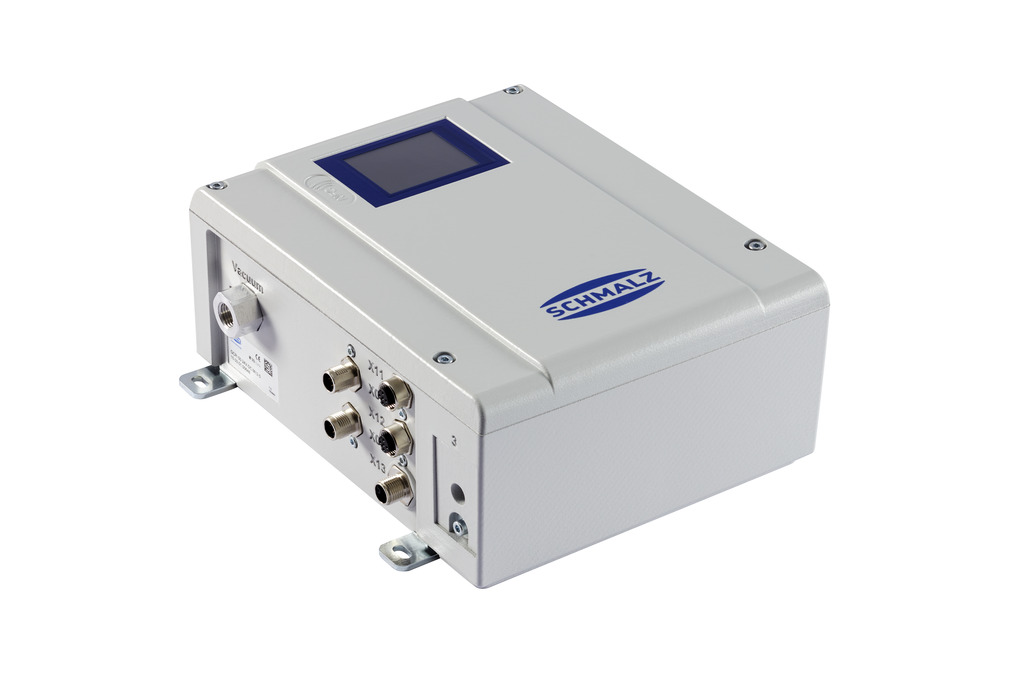
Electric Compact-Pumps GCPi
- Suction rate: 46 l/min
- Max. vacuum: 80 %
- Voltage: 24 V-DC
- Power: 55 W
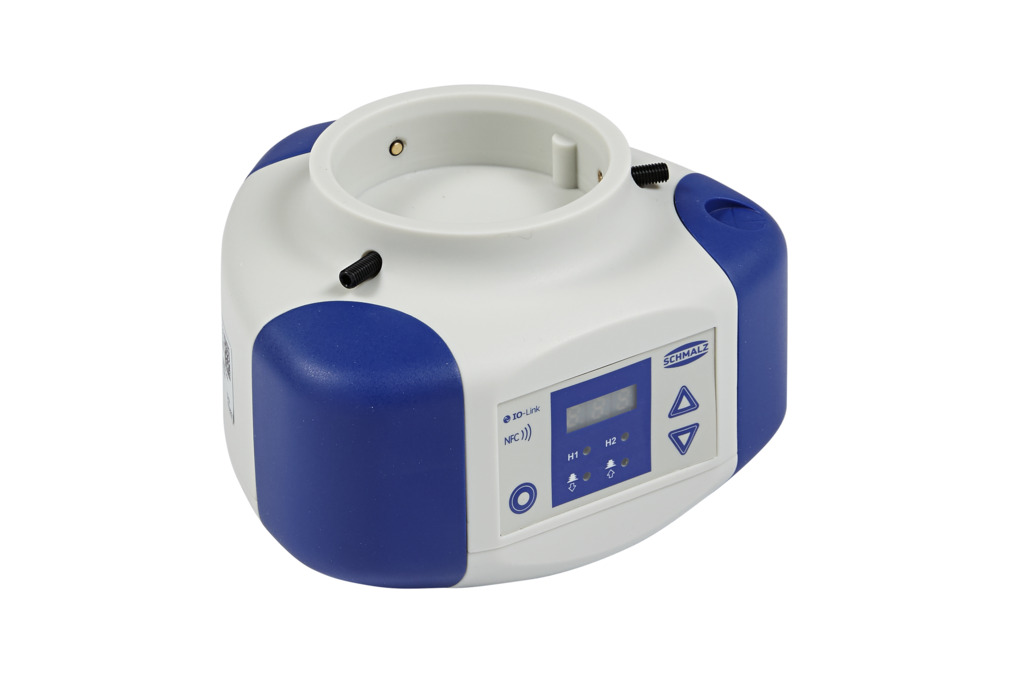
- EFFICIENT
Vacuum Generators ECBPi
- Max. 12 l/min suction rate
- Max. vacuum: 75 %
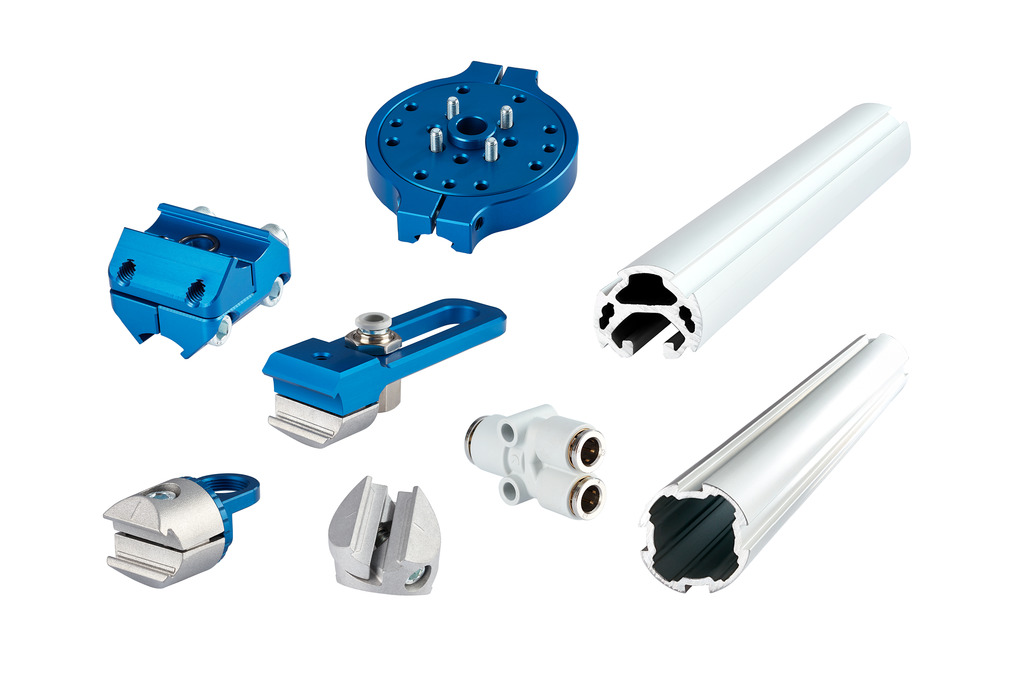
Modular Gripper System PXT
- Suitable flange plates for common robot types or universal flange
- Mounting profile with internal vacuum guide
- Compatible to all Schmalz components