
Logistics 4.0
Logistics 4.0 refers to the end-to-end integration of material and information flows in intra-logistics. Inventory levels, transport orders, and equipment statuses are tracked in real time and exchanged between vehicles, machines, and software. Based on this data, transport and order-picking processes are largely self-managing rather than being centrally planned in advance.
As a subset of Industry 4.0, Logistics 4.0 applies its principles to the flow of goods and materials. The production-side perspective is described by Production 4.0.
What Sets Logistics 4.0 Apart from Traditional Intra-Logistic
The difference lies not in the technology, but in the control logic. In a conventionally controlled system, a central system defines the processes in advance; deviations are corrected afterward. In Logistics 4.0, decisions are made where the data is generated:
- Real time instead of a cutoff date: Inventory levels and order statuses are available continuously, not just after manual confirmation.
- Decentralized decision-making: A vehicle selects its own route; software assigns orders based on current capacity utilization.
- End-to-end connectivity: Warehouse management, transport control, and plant technology all access the same data.
- Gradual scalability: Capacity grows through the addition of vehicles or workstations, not through facility renovations.
This transforms pre-planned processes into a system that continuously adjusts itself. The material flow no longer follows a fixed plan but rather the current order situation. This is particularly relevant today: The approach mitigates the noticeable shortage of skilled workers, simplifies flexible scaling in operations, and reliably absorbs even unexpectedly sharp fluctuations in orders.
How Goods and People Come Together
How goods and people interact determines the storage facility’s layout, investment, and flexibility. Two principles are at odds with each other, and the difference lies primarily in the infrastructure: Goods-to-Person requires a planned facility and, in return, delivers high, consistent throughput. Robots-to-Goods does not require permanently installed technology and scales with the number of vehicles.
Goods-to-Person: the goods come to the person
In the Goods-to-Person (G2P) principle, it is not the person who moves toward the goods, but the goods that move toward the person. Stacker cranes, shuttle systems, or transport vehicles bring containers and trays to a fixed picking station; the employee retrieves the required items, and the load carrier returns to the storage facility.
The benefit lies in the elimination of walking distances, which account for the largest portion of picking time in manual storage facilities. This requires a permanently installed system that must be sized in advance. If a robot cell takes over the workstation instead of a human, this is referred to as Goods-to-Robot (G2R).
Robots-to-Goods: the robot goes to the goods
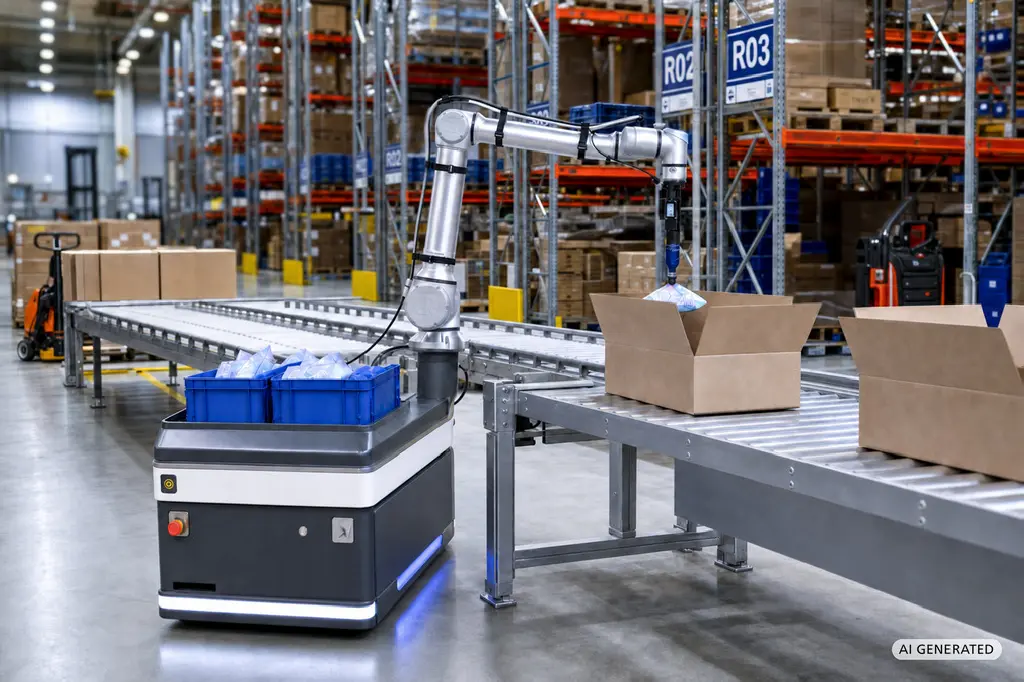
Robots-to-Goods (R2G) reverses the principle: Mobile robots navigate the warehouse aisles on their own and pick up the items directly from the shelf. This is made possible by mobile manipulators – mobile robots equipped with an arm and a gripping system.
Because no shelving or shuttle technology needs to be installed, the system can be introduced gradually into an existing storage facility – capacity is increased through the addition of vehicles, not through a major renovation.
What Are the Building Blocks of Logistics 4.0?
Logistics 4.0 is not a single product, but rather the interplay of multiple levels. In each case, what matters most is not so much the function itself as the data it contributes:
- Mobile Robotics: Autonomous mobile robots and driverless transport systems handle material transport. For Logistics 4.0, their data trail is just as important—each vehicle reports its position, order status, and utilization.
- Identification: Barcodes, Data Matrix codes, and RFID link the physical load carrier to its data record. Without this association, any real-time analysis remains incomplete.
- Networked Components: Sensors and actuators report their status data to higher-level systems via interfaces such as IO-Link, making deviations visible before they lead to a shutdown.
- Software Level: Warehouse management systems, transport control systems, and ERP systems exchange orders and inventory data via defined interfaces.
- Open standards: Vendor-neutral interfaces such as VDA 5050 decouple vehicles from the control software and enable mixed fleets.
Opportunities and Challenges of Logistics 4.0
The benefits of logistics 4.0 stem less from saving individual steps than from the flexibility of the overall system.
Opportunities
- Transparency: Inventory levels, capacity utilization, and order progress can be viewed at any time, rather than only after the end of the shift.
- Fault tolerance: If one component fails, another vehicle takes over the order or the software selects an alternative route. In rigidly linked systems, however, the entire line comes to a standstill.
- Adaptability: Seasonal peaks and changing order structures can be accommodated without having to reconfigure the system.
- Reduced Workload: Recurring transports and walking routes are eliminated—an argument that gains weight given the shortage of skilled workers.
Challenges
- Data quality: A system that operates based on real-time data is only as good as the inventory management underlying it.
- Interfaces: Legacy siloed systems without open interfaces are the most common obstacle in practice.
- Investment Planning: The benefits often only become apparent when multiple components work together, while the costs are incurred immediately.
- Skills: Transport tasks are transformed into monitoring and troubleshooting tasks; this changes requirements and roles.
- IT Security: Connected vehicles and systems expand the attack surface and must be incorporated into the operation’s IT security strategy.
Související pojmy
Často kladené otázky
What distinguishes Logistics 4.0 from Industry 4.0?
Logistics 4.0 is the subset of Industry 4.0 that focuses on the flow of goods and materials. While Industry 4.0 describes connected production as a whole, the same principles—real-time data, connectivity, and decentralized decision-making—apply in Logistics 4.0 to the journey of goods from receipt through storage to shipment.
What is a smart warehouse?
A smart warehouse is a storage facility in which inventory, transportation, and order fulfillment are tracked and managed largely autonomously using networked technology. The term thus describes the implementation of Logistics 4.0 at the level of a single location.
Where is the best place to start with logistics 4.0?
The best way to get started with Logistics 4.0 is through a single, clearly defined process with a high repetition rate – often transportation between two fixed points or a palletizing task. The key prerequisites for this are, above all, a high degree of standardization, a robust database of inventory and orders, and a warehouse management system with open interfaces.