
Theoretical Holding Force of a Suction Cup
To calculate the theoretical holding force, we show and describe the three most important and most frequently occurring load cases (handling sequences).
Important:
For the following, simplified representations of the load cases the calculation must be based on the worst load case with the highest, theoretical holding force. This is the only way to ensure that the suction cup grips the workpiece safely during the entire handling process.
Safety factor S:
The safety factor S must be adjusted in accordance with the condition of workpiece surface . The safety factor has a minimum value of 1.5 for smooth and dense workpieces. A safety factor of 2.0 or greater must be used for critical, heterogeneous, porous, rough or oiled workpieces.
Friction coefficient μ:
The friction coefficient μ describes the relationship between friction force and normal force. We cannot issue generally valid specifications for the friction coefficient between suction cup and workpiece. The friction coefficient μ therefore has to be determined correctly through tests.
The following can be used as reference values.
0.2 ... 0.3 | for wet surfaces |
0.5 | for wood, metal, glass, stone, etc. |
0.6 | for rough surfaces |
Calculation for oiled surfaces:
For standard suction cups without specified lateral force, the recommended reference value is μ = 0.1 to 0.3. To obtain a more precise value, tests must be completed on the original workpiece.
For suction cups that have an explicitly specified lateral force on a dry or oiled surface, the friction coefficient μ can be calculated using the following formula:
μ = FR / FN
Lateral force on a dry or oiled surface/suction force
The calculated μ value can then be used in the formula of the respective load case (I to III).
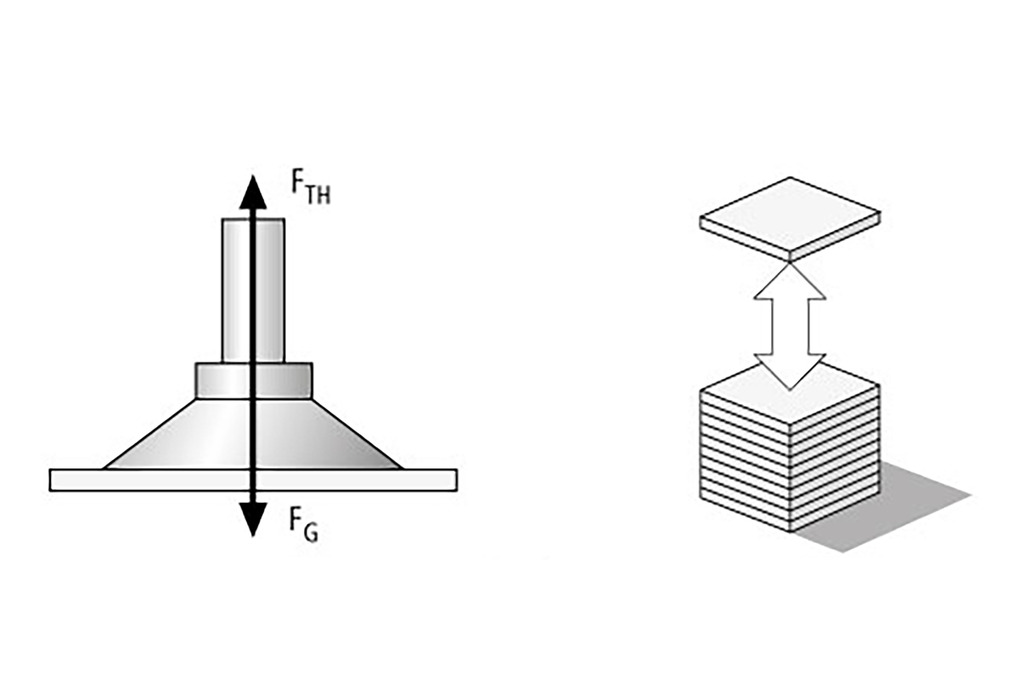
Typical load cases
Load case I – Suction cup horizontal, direction of force vertical
The workpiece (in this case the steel sheet with the dimensions 2.5 x 1.25 m) is lifted from a pallet. The workpiece is lifted with an acceleration of 5 m/s2 (no transverse movement).
FTH = m × (g + a) × S
FTH = theoretical holding force [N]
m = Weight [kg]
g = Gravity [9.81 m/s2]
a = Acceleration [m/s2] of the system
S = Safety factor
Our example:
FTH = 61.33 kg × (9.81 m/s² + 5 m/s²) × 1.5
FTH = 1,363 N
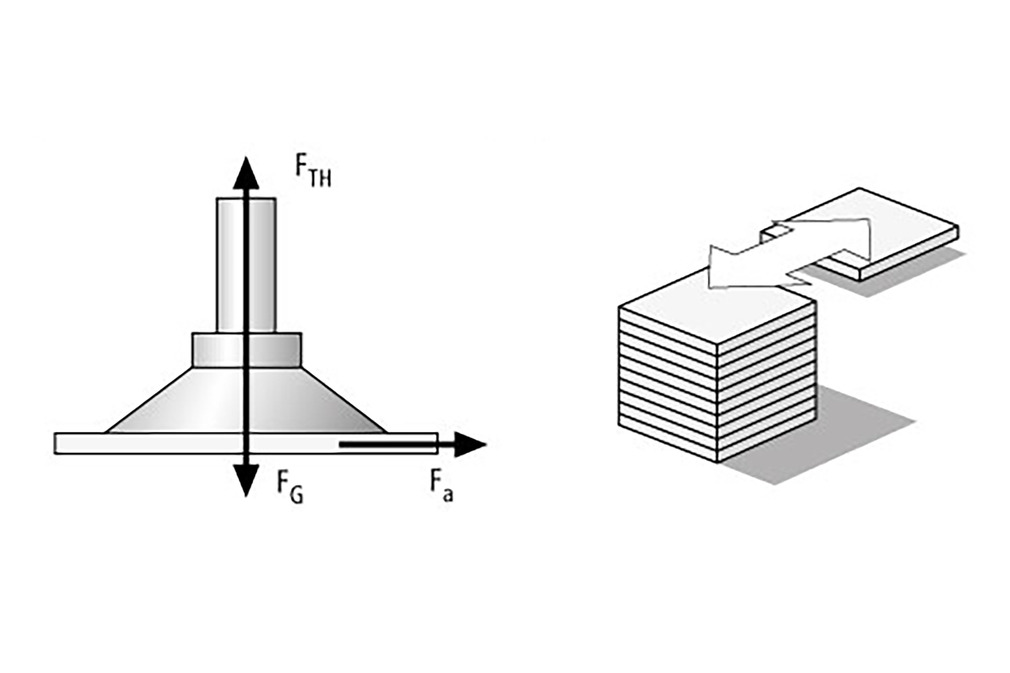
Load case II – Suction cup horizontal, direction of force horizontal
The workpiece (in this case the steel sheet with the dimensions 2.5 x 1.25 m) is lifted up vertically and transported horizontally. The acceleration is 5 m/s².
FTH = m × (g + a ⁄ μ) × S
FTH = theoretical holding force [N]
Fa = Acceleration force = m x a
m = Weight [kg]
g = Gravity [9.81 m/s2]
a = Acceleration [m/s2] of the system (keep in mind Emergency Stop situations!)
μ = Friction coefficient
S = Safety
Our example:
FTH = 61.33 kg × (9.81 m/s2 + 5 m/s2 ⁄ 0.5) x 1.5
FTH = 1,822 N
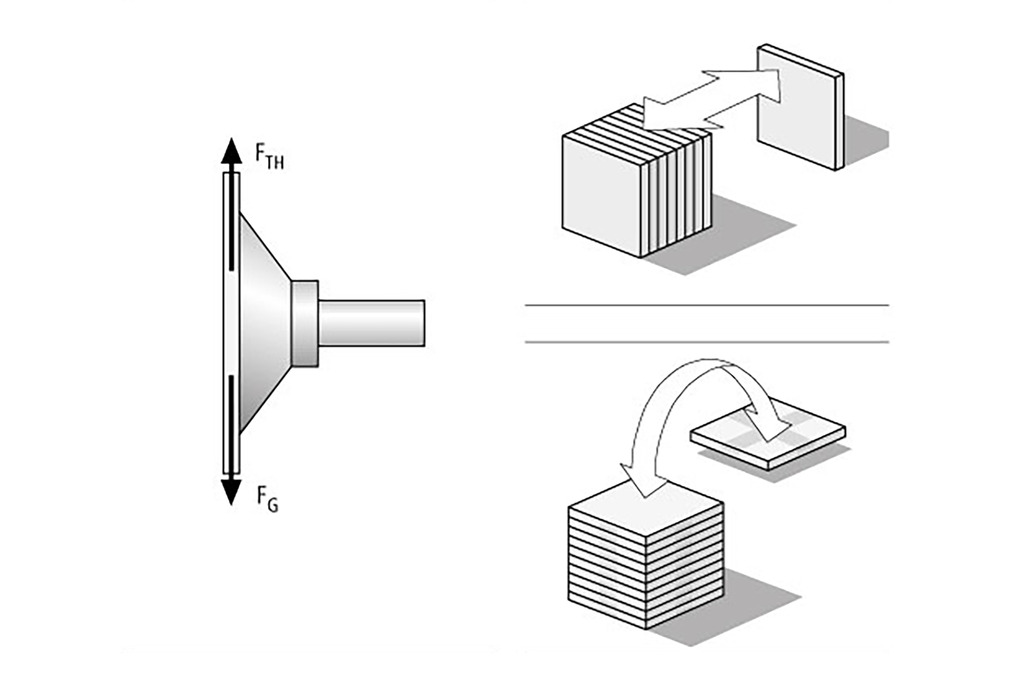
Load case III – Suction cup vertical, direction of force vertical
Description of load case: The workpiece (in this case the steel sheet with the dimensions 2.5 x 1.25 m) is picked up from a pallet and moved with a rotary motion at an acceleration of 5 m/s2.
FTH = (m ⁄ μ) × (g + a) × S
FTH = theoretical holding force [N]
m = Weight [kg]
g = Gravity [9.81 m/s2]
a = Acceleration [m/s2] of the plant (keep in mind Emergency Stop situations!)
μ = Friction coefficient
S = Safety
Our example:
FTH = (61.33 kg ⁄ 0.5) x (9.81 m/s2 + 5 m/s2) x 2
FTH = 3,633 N
Comparison
For our scenario, the workpiece is lifted off a pallet, moved to the side and placed on a machining center. The rotary motion from load case III is not needed in this application, therefore one only needs to consider the result from load case II. The result in this case is a maximum theoretical holding force (FTH) of 1,822 N. This theoretical holding force acts on the suction cup during horizontal transport of the workpiece. The following calculations are based on this value to safely solve the task.