
Exoskeleton
An exoskeleton—also known as an exosuit or, in English, a “muscle suit”—is a support system worn on the body that provides mechanical support to muscles and joints during physically demanding activities. The term literally means “external skeleton” and originates from biology, where it refers to the hard outer shell of insects and crustaceans. In engineering, an exoskeleton describes a wearable design that absorbs, redirects, or reinforces forces, thereby reducing the strain on the musculoskeletal system.
There are essentially two major areas of application: industrial exoskeletons, which protect healthy workers in industry, skilled trades, and logistics from overexertion, and medical exoskeletons, which are used in rehabilitation and therapy—for example, to enable people with spinal cord injuries to stand and walk.
Exoskeleton vs. Endoskeleton
The opposite of an exoskeleton is the endoskeleton—the internal skeleton found in vertebrates, including humans. While the endoskeleton supports the body from the inside, a technical exoskeleton is attached to the outside of the body and takes over a part of the work of supporting and stabilizing it. An exoskeleton is not a robot in the strict sense of the word: Although active exoskeletons are equipped with motors and Energy Storage systems and thus move under their own drive, they follow the movements and intentions of the wearer and provide targeted support without imposing their own movements.
How does an exoskeleton work?
The basic principle is similar across all shapes: An exoskeleton diverts loads away from body structures under particular strain and distributes them to more stable areas or absorbs them mechanically. This relieves the active muscles, which would otherwise have to perform all the work involved in maintaining posture and lifting.
Technicaly, this is achieved in various ways—through load-bearing elements capable of absorbing the stresses, supported, for example, by spring elements, gas-pressure dampers, or, in motorized models, by drives and sensors. Which solution is suitable for which application depends on the drive type (passive or active) and design (rigid or soft).
Types of Exoskeletons
By Body Region Supported
The key factor in making a selection is usually which body region the exoskeleton is intended to relieve:
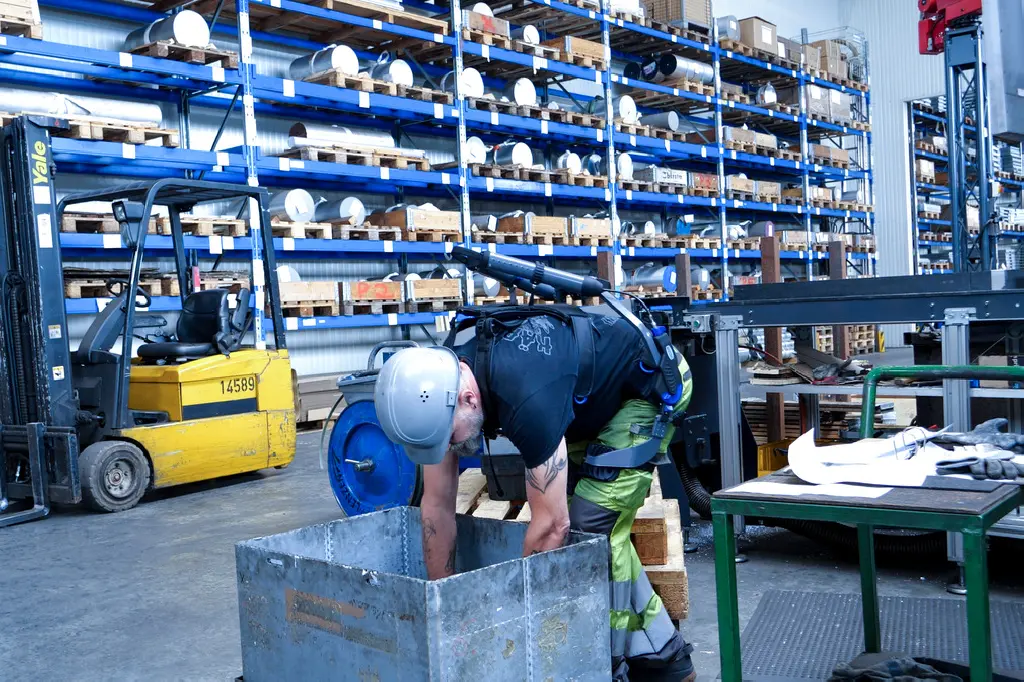
- Back and forward-bending exoskeletons relieve pressure on the lumbar spine during lifting and when leaning forward. They are most widely used in logistics, industry, and skilled trades.
- Leg, knee, and hip exoskeletons assist with squatting, kneeling, and standing up, as well as providing stability during vertical tasks.
- Shoulder and overhead exoskeletons provide targeted support for the arms during manual tasks at chest height and overhead, such as in mounting, installations, or drywall construction.
- Hand and finger exoskeletons reinforce gripping strength during prolonged or force-intensive grasping tasks.
- Full-body exoskeletons combine multiple support areas and are primarily used in specialized or military applications.
By Drive System and Design
Regardless of the body region being supported, exoskeletons can be classified based on their drive system and design. In terms of drive systems, a distinction is made between passive systems without a motor and active systems with a motor and power source (e.g., a battery). With regard to design, a distinction is made between rigid exoskeletons with a fixed frame and so-called soft exoskeletons, which consist of flexible, textile materials.
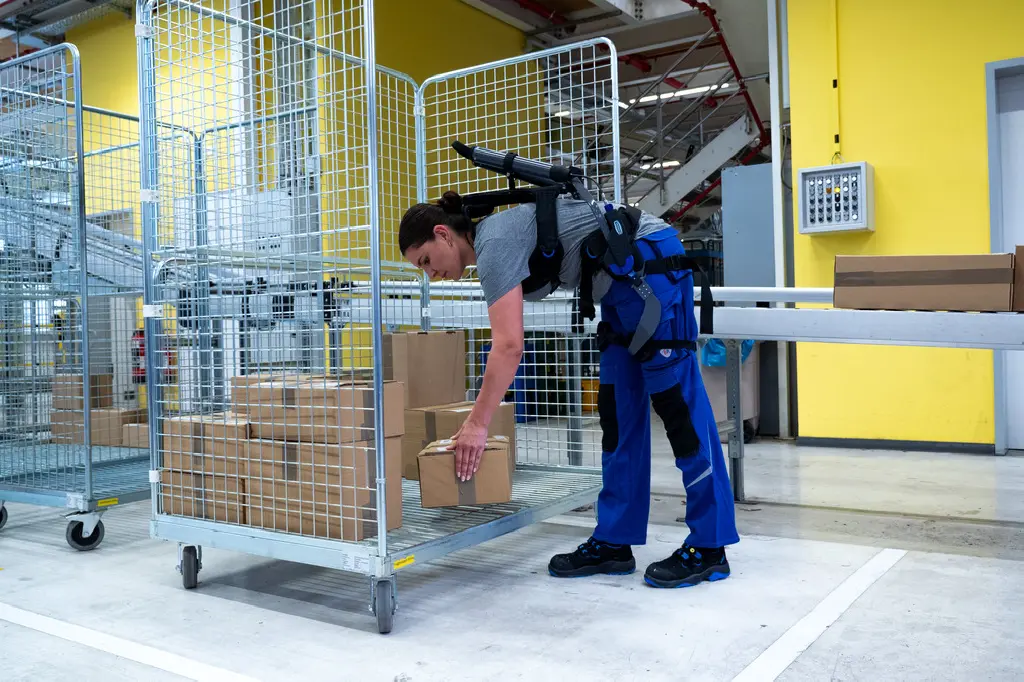
The NEXO Pro forward bend exoskeleton from Schmalz
The NEXO Pro from Schmalz is a rigid forward bend exoskeleton: It relieves pressure on the lumbar spine in the lower back during lifting and bending forward. It is a passive system—it operates purely mechanically, without a motor or battery.
Areas of Application
Industrial exoskeletons are used wherever physically demanding movements cannot be automated—or can only be partially automated—such as:
- Logistics and storage: order picking, palletizing and depalletizing, loading and unloading—tasks involving frequent lifting.
- Trades and construction: overhead work, drywall installation, tiling and painting, and repetitive lifting of material.
- Manufacturing and mounting: Material handling, assembly line and mounting work, production.
- Care and healthcare: Repositioning and mobilizing patients.
- Military and emergency services: Carrying heavy equipment over long distances.
Advantages and Disadvantages of Exoskeletons
Benefits
- Relief for strained muscles and joints, and thus reduced physical fatigue
- Potential to reduce strain-related complaints and absences
- More consistent performance throughout the entire shift
- A tangible contribution to occupational health and employer attractiveness, especially given an aging staff and a shortage of skilled workers
Disadvantages and Limitations
- Not a substitute for proper lifting techniques, technical aids, and ergonomically designed work organization
- An adjustment period and employee acceptance are required
- Not every task or body part can be supported equally well
- In very confined spaces, freedom of movement may be restricted
- Active systems add extra weight and require additional maintenance
Exoskeletons in Occupational Safety: Risk Assessment and Practical Application
Exoskeletons specifically reduce physical strain right where it occurs—when lifting heavy loads, working overhead, or in a bent-over position. In occupational safety, they are classified as a supplementary tool that must have an orientation that is tailored to a specific strain situation.
Before deployment in the workplace, therefore, a task-specific risk assessment is required: It determines which system is suitable for the respective workstation, whether the fit and comfort are appropriate, and whether the exoskeleton creates any new strains—such as from additional weight or restricted freedom of movement. Occupational accident insurance associations and the DGUV provide guidance on this topic.
Frequently asked questions
What is the difference between a passive and an active exoskeleton?
A passive exoskeleton operates purely mechanically, without electricity, motors, or batteries; an active model uses motors and sensors to provide motorized assistance.
|
Feature |
Passive |
Active |
|---|---|---|
|
Drive |
Spring mechanism, no battery |
Motor + battery (regular battery replacement required) |
|
Weight |
Significantly lighter than active systems |
Heavier due to drive technology |
|
Cost |
Only initial purchase costs; no battery wear and no maintenance costs |
Higher purchase and operating costs |
|
Suitability |
Repetitive bending, lifting, and static postures |
Very heavy loads, e.g., over 30 kg |
For most applications in logistics, trades, and industry, a passive system offers the best balance of load-relieving effect, comfort, and total cost.
What is the difference between a rigid and a soft exoskeleton?
A soft system consists exclusively of elastic textile straps and requires no rigid components. A rigid exoskeleton, on the other hand, transfers the load from the upper body past the spine to the hips via a rigid frame; the thighs serve as a counter-support to absorb the supporting forces.
Soft System
- Consists only of elastic straps, without a rigid frame.
- The spine and intervertebral discs remain fully loaded.
- Advantageous in very confined spaces (e.g., baggage handling).
- Less support during lifting.
Rigid System
- The frame transfers the upper body’s weight past the spine.
- The intervertebral discs are not subjected to additional compression.
- Passive support of up to 30% of the required muscle activity.
- Suitable for tasks involving a static forward-leaning posture, heavy lifting, and bending from a squatting position.
For tasks involving repeated lifting and bending, a rigid system provides measurably greater relief.