
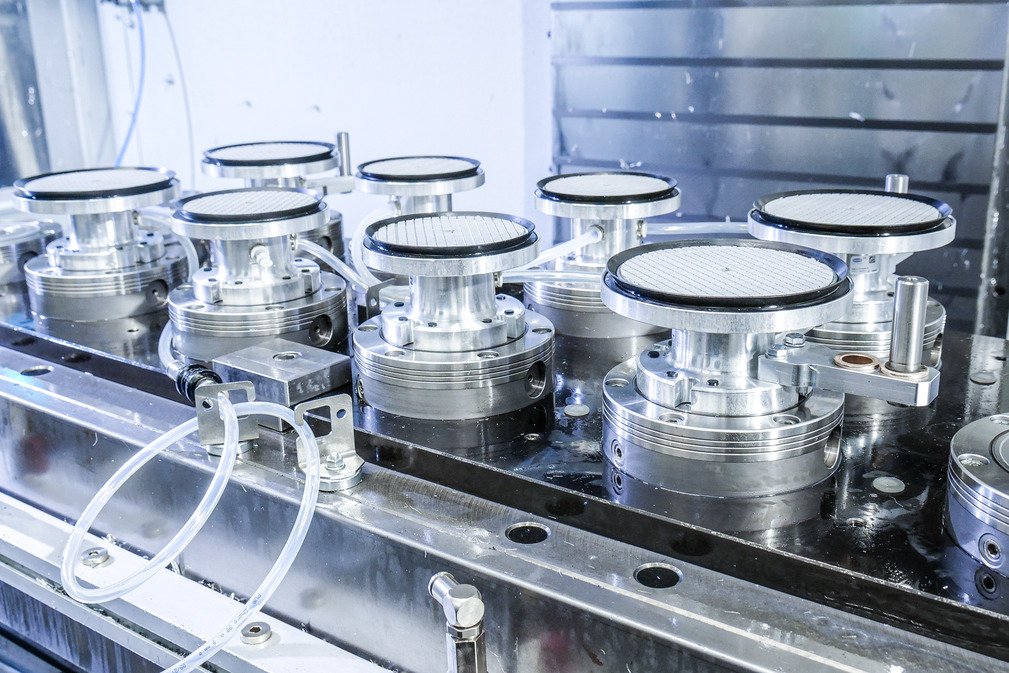
Clamping Equipment for Metal and Plastic Processing
- Vacuum clamping technology for CNC machining of metal or plastic workpieces
- With special friction pad for high clamping forces
- Tight tolerances for high dimensional requirements
Show category
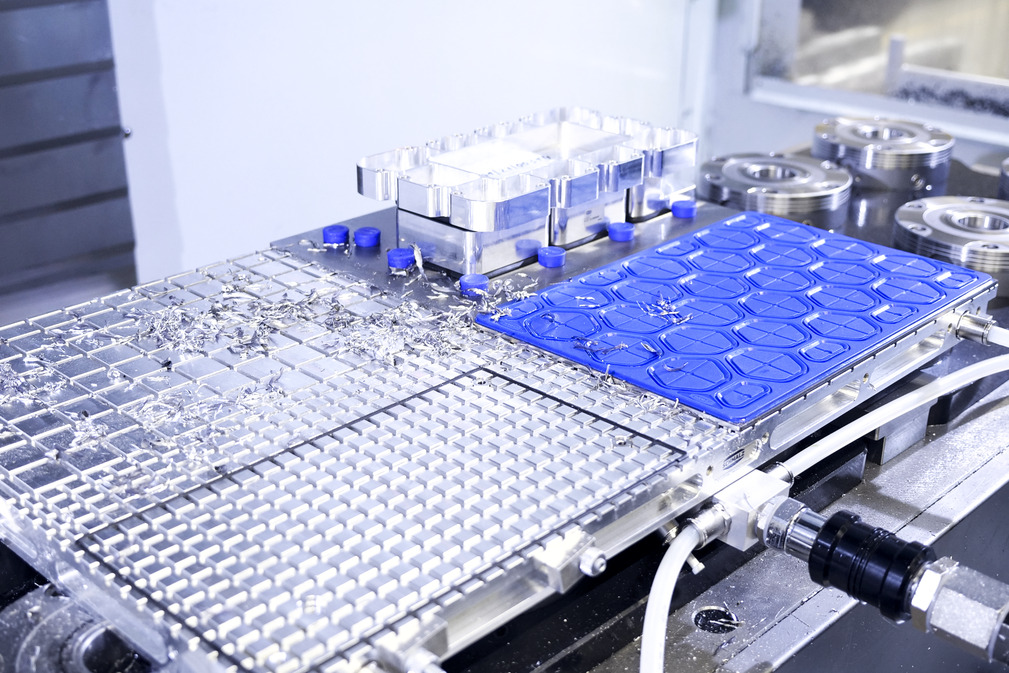

Vacuum clamping technology is particularly well-suited for large-surface-area, thin-walled, dimensionally unstable, or scratch-sensitive workpieces.
The even distribution of force via atmospheric vacuum prevents warping or deflection during machining. This allows components to be clamped with virtually no distortion, without creating local pressure marks or deformations caused by conventional mechanical clamping equipment.
Optimal materials in practice:
Yes, absolutely. Vacuum clamping technology is ideal for delicate, thin-walled, or easily deformable workpieces.
Since the holding force is applied evenly across the entire surface via atmospheric vacuum, localized clamping peaks caused by mechanical clamps or vises are completely avoided. This ensures that no pressure marks or scratches occur, especially on thin-walled aluminum components, coated sheet metal, or workpieces with sensitive visible surfaces. At the same time, the sides of the workpiece remain largely accessible, enabling complex machining operations to be performed in a single setup.
Yes. Vacuum clamping systems are ideal for both 5-axis and 6-axis machining.
Since the workpiece is clamped across its entire surface from the bottom, there is no need for obstructive mechanical clamping claws. This offers the major advantage of completely unobstructed access. As a result, complex machining operations can often be performed on five sides in a single setup, without the need for additional re-clamping operations. At the same time, thin-walled components are clamped in a way that is gentle on the material and prevents warping.
Important requirements for the process:
Schmalz offers specific solutions for each of the various production stages:
There is no one-size-fits-all solution for CNC vacuum clamping; rather, there are two primary approaches that differ depending on the part geometry and milling forces:
Yes. In many cases, a vacuum clamping system can be easily retrofitted to existing CNC machining centers—regardless of the machine manufacturer. Such an upgrade is generally much more cost-effective than investing in a new machine.
All common machine table systems are supported. On smooth tables or T-slot sheets, the vacuum attachment module or grid plate is simply secured mechanically or via a zero-point clamping system.
When selecting the right vacuum generator for metal and plastic processing, you must primarily ensure a high vacuum level for maximum clamping forces, as well as intelligent energy and fluid management. Since CNC processes for these materials depend significantly on the type of workpiece (porous or dense) and are usually air-tight, Schmalz application experts generally recommend high-performance, oil-lubricated vacuum pumps.
When making your selection, pay attention to the following key features:
Depending on the application, CNC clamping systems use either electric vacuum pumps or pneumatic vacuum generators. The key factors in selecting the appropriate system are primarily workpiece size, leakage rate, machining process, and the required holding force:
In addition, intelligent functions such as vacuum monitoring, liquid separation, or energy-saving controls play a crucial role in ensuring process reliability and energy efficiency in automated manufacturing.