Smart Vacuum Pump GSP
Power Without Compressed Air: Electrical Vacuum Generators for Maximum Independence and Minimal Energy Consumption
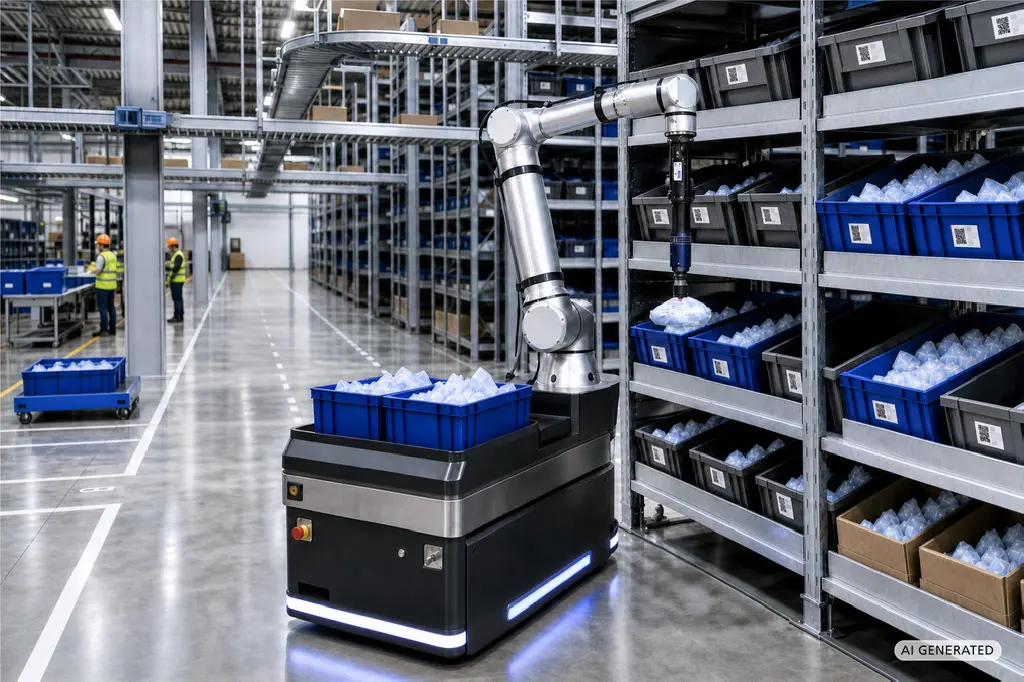
For flexible and mobile robotics applications
For up to 90 % energy savings*
For quick and easy commissioning
Power Without Compressed Air: Electrical Vacuum Generators for Maximum Independence and Minimal Energy Consumption
For flexible and mobile robotics applications
For up to 90 % energy savings*
For quick and easy commissioning
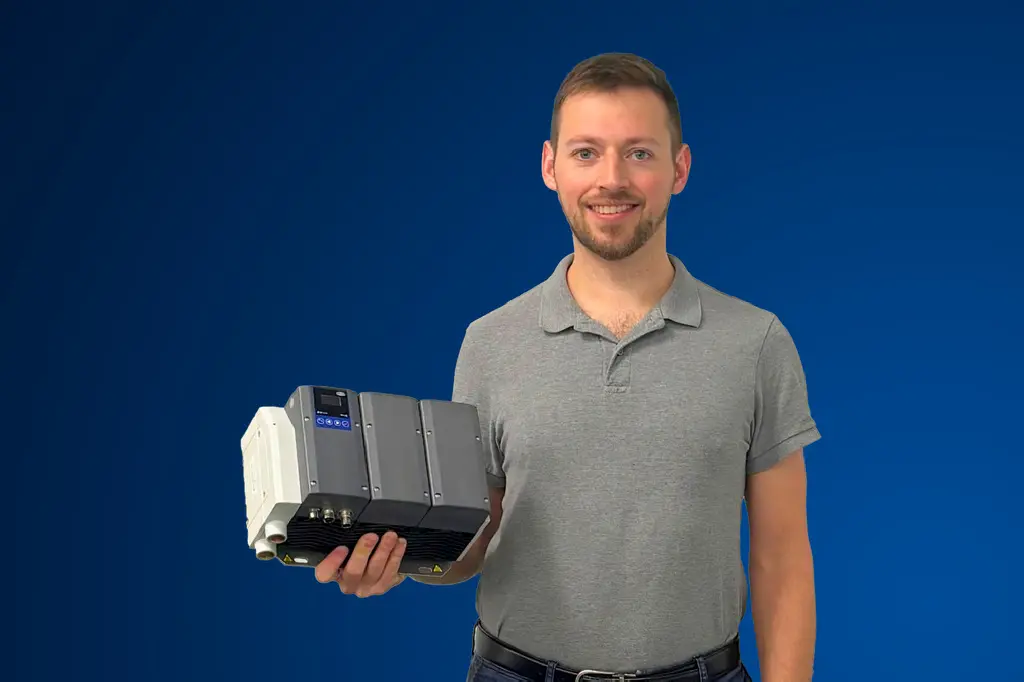
Flexibility, energy efficiency, and scalability are key success factors today – whether in automated guided vehicles (AGVs), autonomous mobile robots (AMRs), or other robot-assisted applications. This is precisely where Schmalz comes in with its unique and high-performance technology.

The Smart Vacuum Pump GSP turns mobile robots into efficient autonomous handling systems
Our high-performance 24 V DC pumps (suction rate 50–150 l/min) with automatic leak detection work anywhere – in stationary systems as well as in autonomous mobile robots (AMRs) and automated guided vehicles (AGVs), with both airtight and porous workpieces.
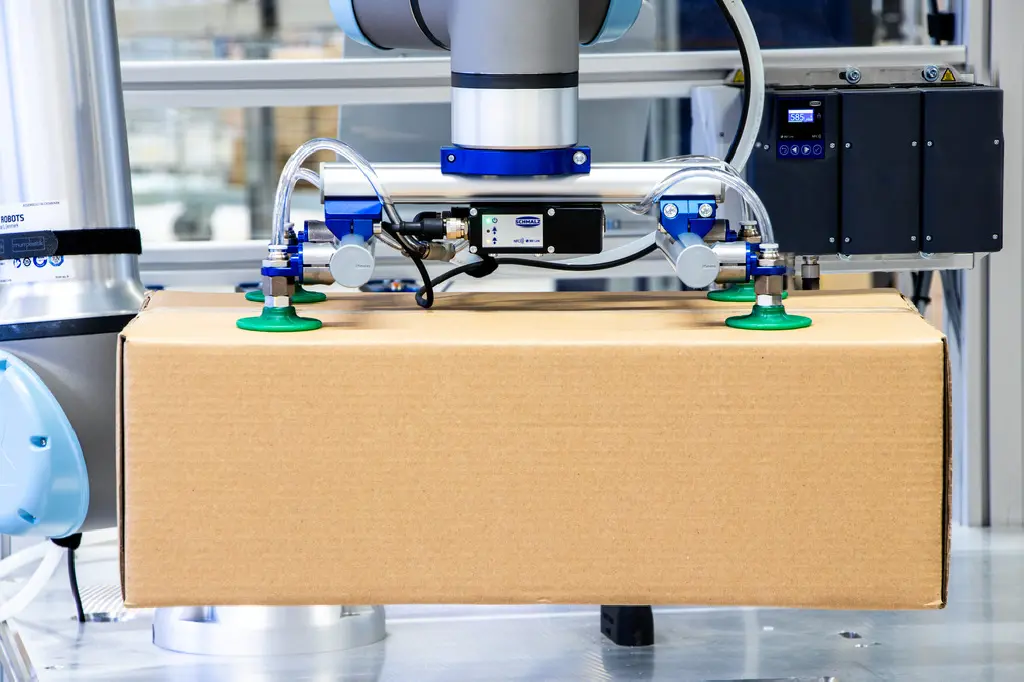
When combined with the electric compact valve LQE, Schmalz creates a perfectly coordinated system. It enables exceptionally fast grip and release times, up to 99 % less energy consumption during release compared to active blow-off with compressed air, and significantly less noise. Vacuum control close to the gripper guarantees maximum safety and monitoring, while automatic adaptation to different workpiece porosities reduces control effort to a minimum.

With the new vacuum pump GSP, Schmalz proves that we are more than just a supplier. Schmalz is a strategic partner for intelligent, process-tailored vacuum solutions. With comprehensive expertise and proven innovation capabilities, we guide you from idea through development to scaled application.
The intelligence of the vacuum pump GSP is evident is evident through the following features:
1) Automatic vacuum control: The pump continuously measures the vacuum level, automatically detects leakage, and compensates for it in real time. It thus adapts to the requirements and ensures safe workpiece handling without over- or under-supply.
2) Demand-driven operation: Runs only at the necessary power level, resulting in energy savings of up to 90 % compared to vacuum pumps without demand-responsive control. Power consumption is reduced to a minimum.
3) Intelligent communication: The electric compact valve LQEi is automatically recognized upon connection and exchanges data with the pump. Relevant process data (e.g., vacuum level) is transmitted directly to your PLC.
The process is monitored via an LCD display, NFC, or IO-Link. The electric vacuum generator can be deployed both mobile on Cobots, AMRs, AGVs, as well as in stationary applications.
The smart vacuum pump GSP from Schmalz is suitable for mobile automation solutions on cobots, AMRs, and AGVs, as well as for stationary handling tasks in production – ideal wherever compressed air is not available, energy needs to be saved, or battery capacity is limited. It handles both airtight and porous materials gently and quietly.
Typical applications are found in the following industries:
The smart vacuum pump GSP saves up to 90 % energy compared to electric vacuum pumps without demand-responsive vacuum control – thanks to its intelligent, demand-based pump control. In addition, the pump generates twice as much flow rate with equal power draw (W) as, for example, rotary vane pumps (at a vacuum level of 600 mbar).
Compared to pneumatic solutions (compressed air with ejectors), the vacuum pump GSP achieves energy savings of up to 90 %, depending on the application.
Additional savings potential: When combined with the compact valve LQE, up to 99 % of the energy used for releasing workpieces can be saved compared to active blow-off with compressed air.
Battery life is affected by a pump’s power consumption. The higher the power consumption and the longer the runtime, the more energy is drawn from the battery. The problem with vacuum pumps without vacuum control is that they run continuously. The smart vacuum pump GSP, on the other hand, regulates itself as needed. As soon as the target vacuum required for safe handling is reached, the power is automatically reduced. This saves up to 90 % energy compared to vacuum pumps without demand-based regulation. At full load, the smart vacuum pump GSP requires only a maximum of 165 W. When combined with the compact valve LQE, energy consumption during release can be reduced by up to 99 % compared to active blow-off with compressed air.
The actual effect always depends on the specific cycle, potential leakage, and the size of the battery. For a precise calculation, we recommend contacting your dedicated representative directly.
There is no general weight specification in kilograms, as the maximum load capacity is not directly limited by the pump, but rather by the material of the workpiece, system leakage, and the dynamics of the robot’s movement. Since the smart vacuum pump GSP can be mounted flexibly (e.g., on the robot base or on axis 3/4) and does not have to be attached directly to the gripper (EOAT) as a load-bearing component, it does not limit the maximum payload.
The maximum number of suction cups does not depend on the pump alone, but also on the required cycle time (evacuation time) or material leakage.
1. Air-tight materials (guideline values for flow rate requirements)
(Formula: Number of suction cups × l/min per suction cup × safety factor 1.5)
2. Porous materials (e.g., cardboard, wood)
The total leakage is decisive. The pump must deliver a higher flow rate than the volume escaping through the material in order to maintain the required vacuum level.
The smart vacuum pump GSP operates completely independently, even without the compact valve LQE. However, for porous workpieces or short cycle times, we recommend using it in combination with the compact valve LQE.
The ectric compact valve LQE offers the following advantages:
Pre-charging means evacuating the vacuum between the pump GSP and the compact valve LQE in advance. When the compact valve LQE opens and the workpiece is to be gripped, this pre-evacuating generates a strong initial suction pulse. This has two advantages: The workpiece is picked up faster (shorter cycle time), and the gripping process is more powerful (safe handling even with porous materials).
After this initial phase, the intelligent pump control automatically shuts off. No additional energy is required to maintain the pre-charge.
During venting, the compact valve LQE opens a controlled connection to the atmosphere. This creates a controlled leak through which the vacuum collapses and the workpiece is released.
Advantages over compressed air blow-off:
Blowing off with compressed air (as with ejectors) is louder and more energy-intensive. Venting with the compact valve LQE, on the other hand, is quiet and energy-efficient while still enabling rapid workpiece release.
The compact valve LQE enables rapid workpiece release: It vents the suction cups directly at the gripper, releasing the workpiece within milliseconds – without any compressed air blow-off. Compared to compressed air blow-off, this saves up to 99 percent of energy during release.
The vacuum pump GSP does not need to be shut off for releasing. The residual vacuum is automatically released via the safety valve on the filter unit.
The switch to the smart vacuum pump GSP pays for itself through energy savings of up to 90 %, avoided compressed air costs, and minimal maintenance downtime – for new installations, there is also no need for an entire pneumatic system.
Your economic benefits at a glance:
For a customized ROI calculation based on your specific conditions, we recommend contacting your account manager: Find your contact now.