

Vacuum Grippers for Humanoid Robots
Electric Vacuum End Effector HXCB: Schmalz’s Innovation for Humanoid Robots
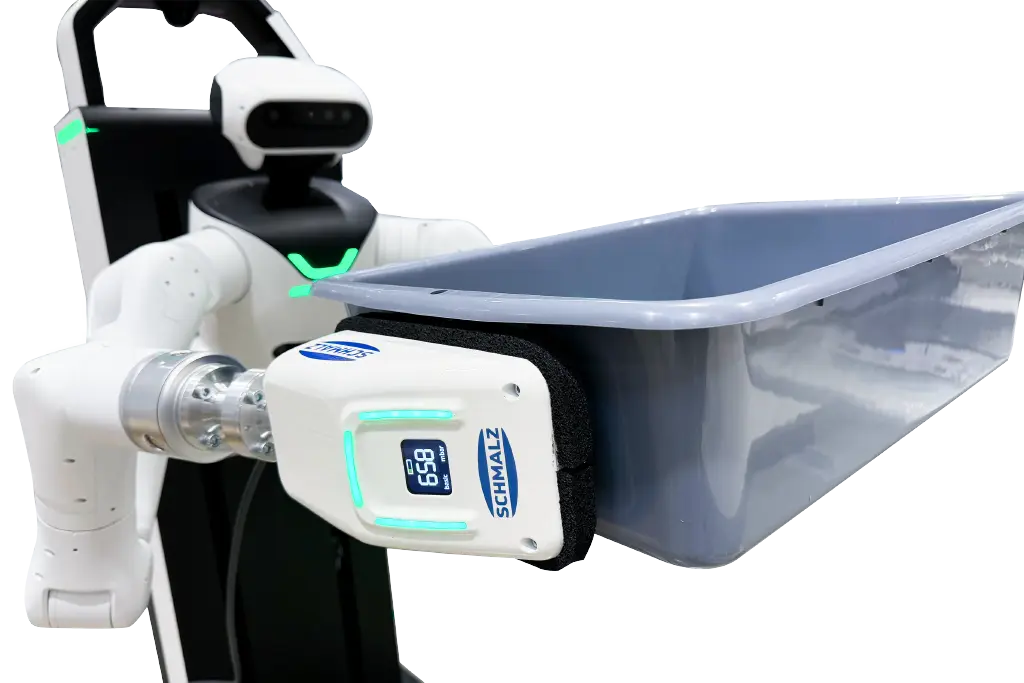
Electric Vacuum End Effector HXCB: Schmalz’s Innovation for Humanoid Robots
Humanoid robots are considered one of the most significant technological developments of our time. Unlike traditional industrial robots, which are typically stationary and designed for a single task, humanoid systems mimic the human form and range of motion. This design allows them to move through environments originally designed for humans - without requiring any modifications to production facilities, storage facilities, or workplaces. This is precisely what makes humanoid robots so promising for the industry of the future.

While humanoid robots have made tremendous advances in locomotion, balance, and perception in recent years, one capability remains particularly challenging: grasping.
The human hand is a highly complex tool - it can grasp a wide variety of shapes, weights, and materials without causing damage. Humanoid robots therefore require grasping solutions that:
are lightweight, so that the robot’s payload capacity and energy efficiency are optimally maintained
are compactly designed to operate collision-free even in tight and dynamic environments
operate self-sufficiently, without relying on an external compressed air supply or complex cabling
grip reliably and precisely, even with varying workpiece geometries and properties
Schmalz addresses this need with the electric vacuum end effector HXCB - a solution for reliable handling with humanoid robots.
Schmalz brings decades of vacuum expertise to humanoid robotics, setting new standards for autonomous gripping with its unique technology.∼ Markus Schmider, Industry and Key Account Manager Robotics
In humanoid robotics, there is frequent discussion about increasingly complex gripping systems. However, for many industrial applications, maximum dexterity is not necessary at all. Especially when handling cardboard boxes, containers, and other flat workpieces, the vacuum principle stands out for its simplicity rather than complexity. Vacuum grippers enable fast, safe, and repeatable gripping with minimal mechanical and control-related effort. No complex controls, no sensitive joints - just targeted functionality. This reduces investment and maintenance costs, minimizes potential sources of error, and increases process reliability during continuous operation. For many applications in logistics and production, the vacuum hand is therefore not only the more economical solution but also the more technically efficient one.

Thanks to their simple design, which features significantly fewer mechanical components and sensors, vacuum grippers reduce both capital and maintenance costs.

The robust operating principle of vacuum grippers minimizes the risk of failure and ensures stable processes during continuous operation.

Even when workpiece properties vary, vacuum grippers ensure reliable and safe gripping.

Their minimal weight makes vacuum grippers ideal for mobile and humanoid robotic systems.

Efficient operation helps conserve battery life in battery-powered systems such as humanoid robots.

Vacuum grippers can be integrated quickly and easily into existing robotic systems.

Low-contact gripping technology enables the safe and damage-free handling of sensitive products and surfaces.
The electric vacuum end effector HXCB is the first to combine an integrated electric vacuum generator with a vacuum gripper in a compact system designed for humanoid robots that need to move freely and handle objects safely. An internal pressure sensor intelligently regulates power consumption - ensuring maximum energy efficiency without relying on external power sources.
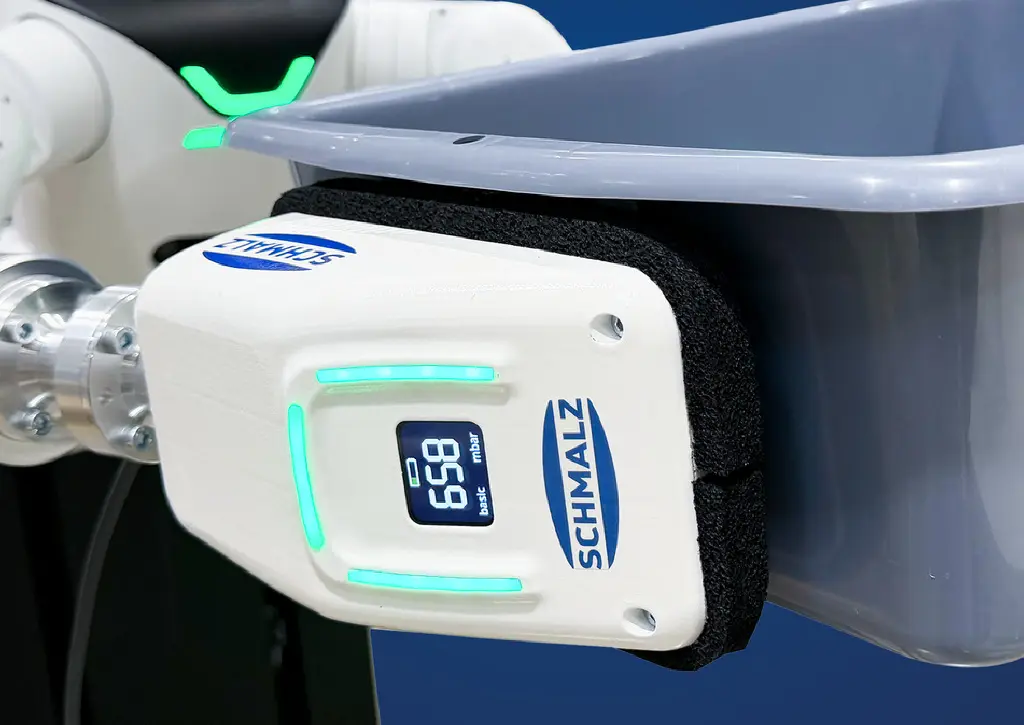

Picking, Sorting, and Transporting Goods
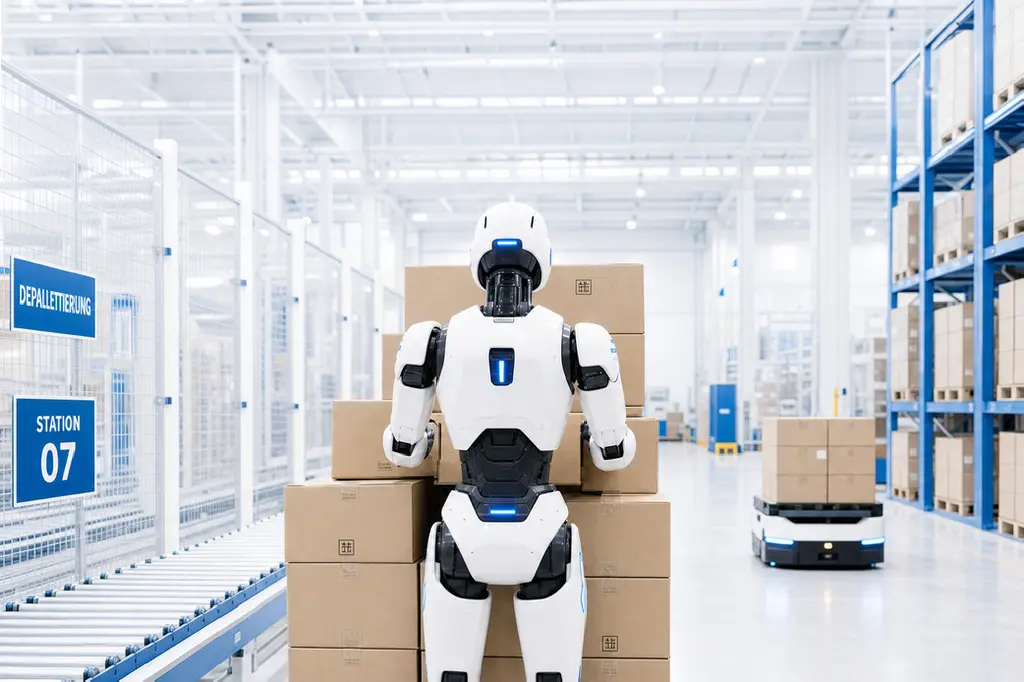
(De-)Palletizing
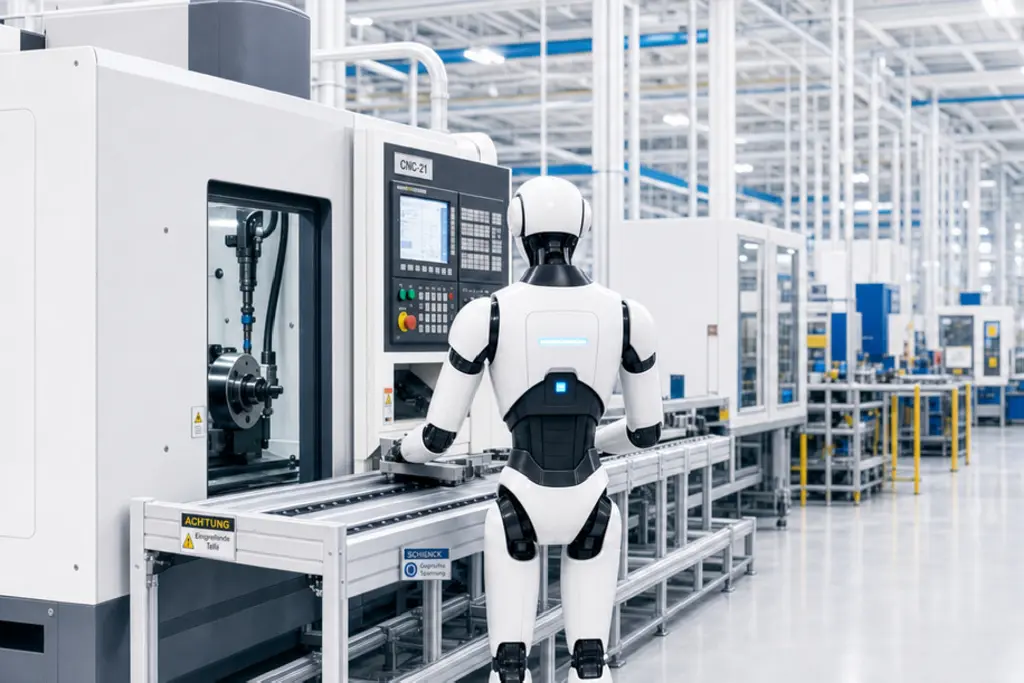
Loading and unloading machinery
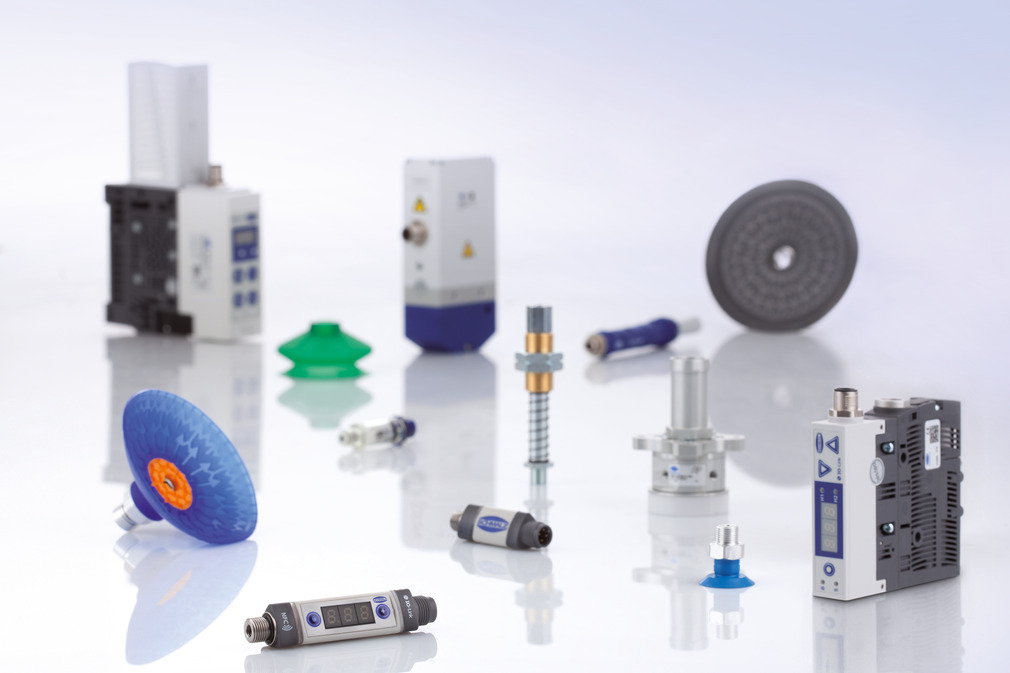
Automation with vacuum is a key to efficient processes. Individual components and ready-to-connect gripping systems from Schmalz are used successfully in various industries and applications.
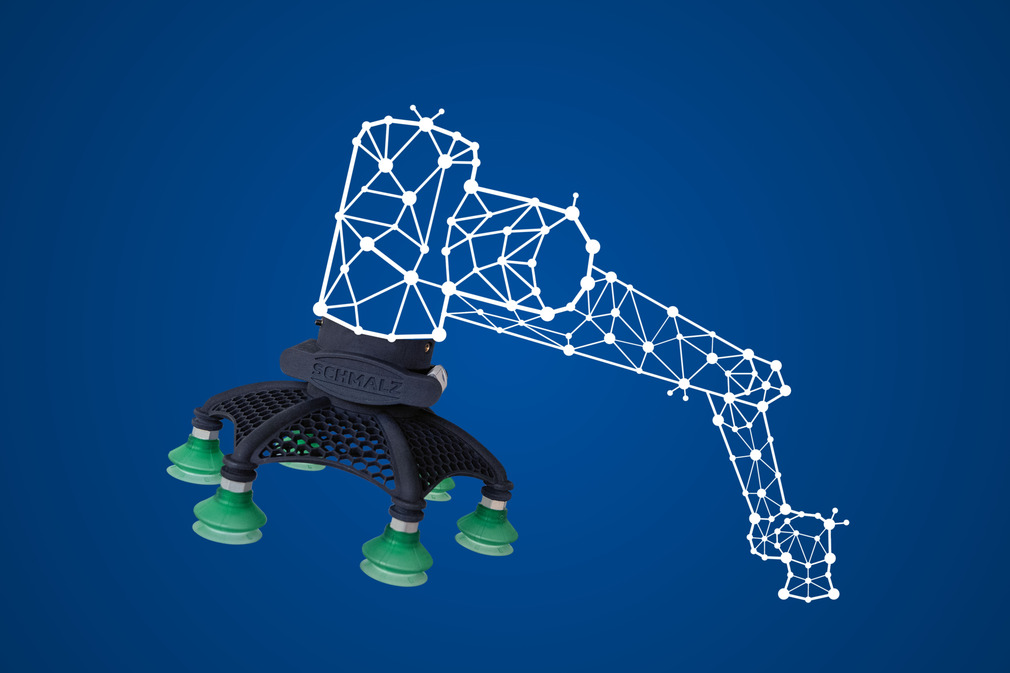
All-round efficient gripping: EOAT solutions from Schmalz for versatile, process-reliable handling in automation.
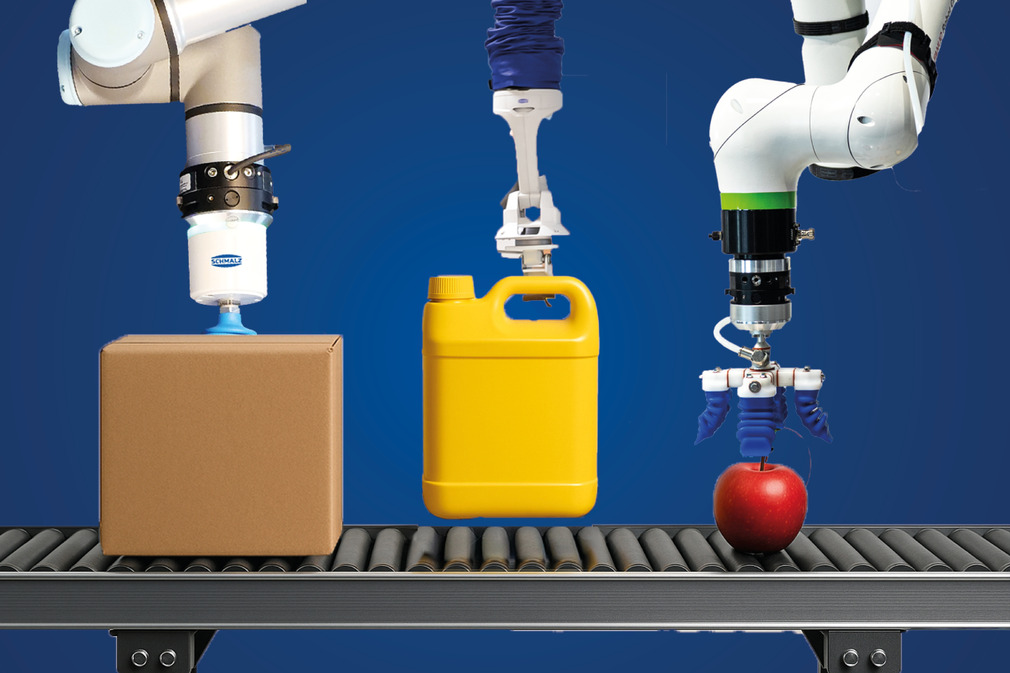
Discover how Schmalz shapes innovations for the future with cutting-edge technologies and deep know-how.

Turn autonomous vehicles into autonomous handling systems: with compact, energy-efficient vacuum solutions for AMRs and AGVs—from electric vacuum generation to complete gripping systems.

Taivaltie 5
FI-01610 Vantaa
The vacuum gripper was developed specifically for humanoid robots and enables safe gripping of smooth and air-tight surfaces. It combines a lightweight, compact design with an integrated electrical vacuum generation system, providing a practical solution for numerous handling tasks in industry and logistics.
Vacuum grippers are based on a relatively simple and cost-effective operating principle. Unlike complex robotic arms, they do not require sophisticated mechanical systems, sensors, or complex control algorithms. As a result, they are more robust, less prone to malfunctions, and offer the potential for a longer service life while also reducing operating and maintenance costs.
A compact electrical diaphragm pump generates the required flow rate and vacuum directly within the gripper. This allows sufficient holding force to be designed - despite limited installation space and low weight - to safely grasp and transport objects.
Thanks to a standardized ISO flange configuration - as is also common with cobots - the gripper can be easily connected mechanically. For electrical control, four pins are sufficient; these are controlled via the robot’s digital inputs and outputs.
The vacuum gripper was developed specifically for handling flat workpieces, cardboard packages, crates, and boxes. It is suitable for applications in which objects can be safely gripped by their surface and the use of a complex five-finger gripper is not technical or economically necessary.
The integration has been deliberately kept simple. Control is handled via a 4-pin interface using digital inputs and outputs. This standard is supported by virtually all robots and control systems, so no complex software modifications are required.
The current gripper is designed for payloads of up to 5 kg. In many cases, however, it is not the gripper itself but the payload capacity of the humanoid robot that represents the actual limitation.
Vacuum gripping works best on smooth surfaces that are largely air-tight. Complex 3D free-form parts can often be handled more safely by mechanical grippers or robotic arms. In addition, the integrated electric vacuum generator can only compensate for a limited amount of leakage. Flexible, highly textured, or air-tight workpieces are therefore only suitable for vacuum gripping to a limited extent. For smooth and air-tight objects, however, the vacuum gripper often offers the simpler, more robust, and more economical solution.
In addition to complex five-finger grippers, simple parallel grippers are also used. These grippers are also relatively simple and cost-effective in design and may already be sufficient for many applications. Vacuum grippers really shine when it comes to the fast and reliable handling of flat, air-tight workpieces.