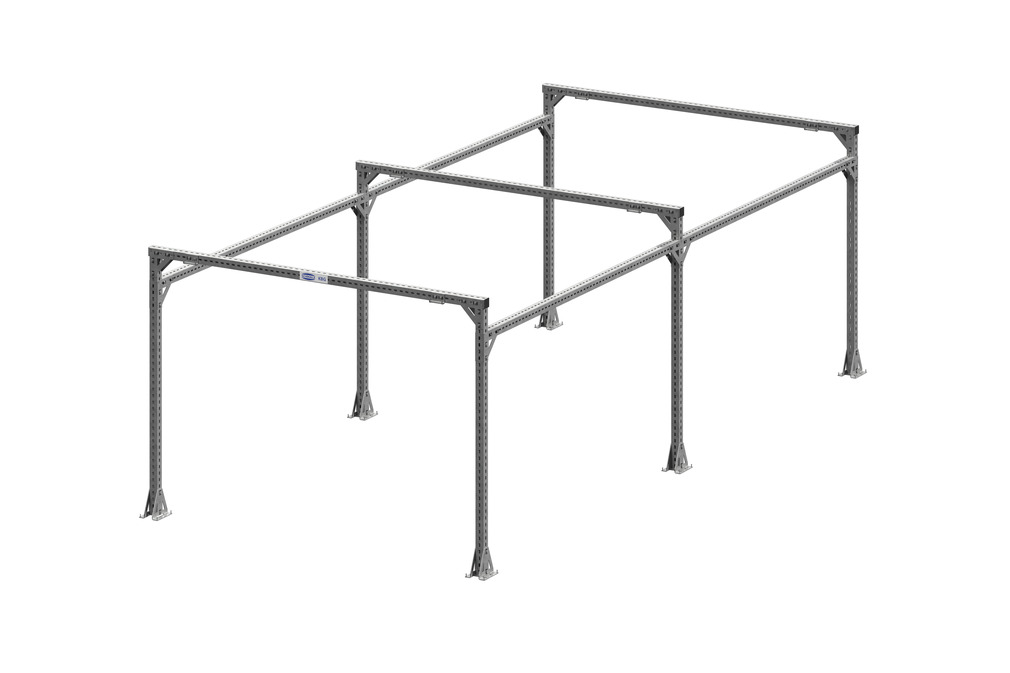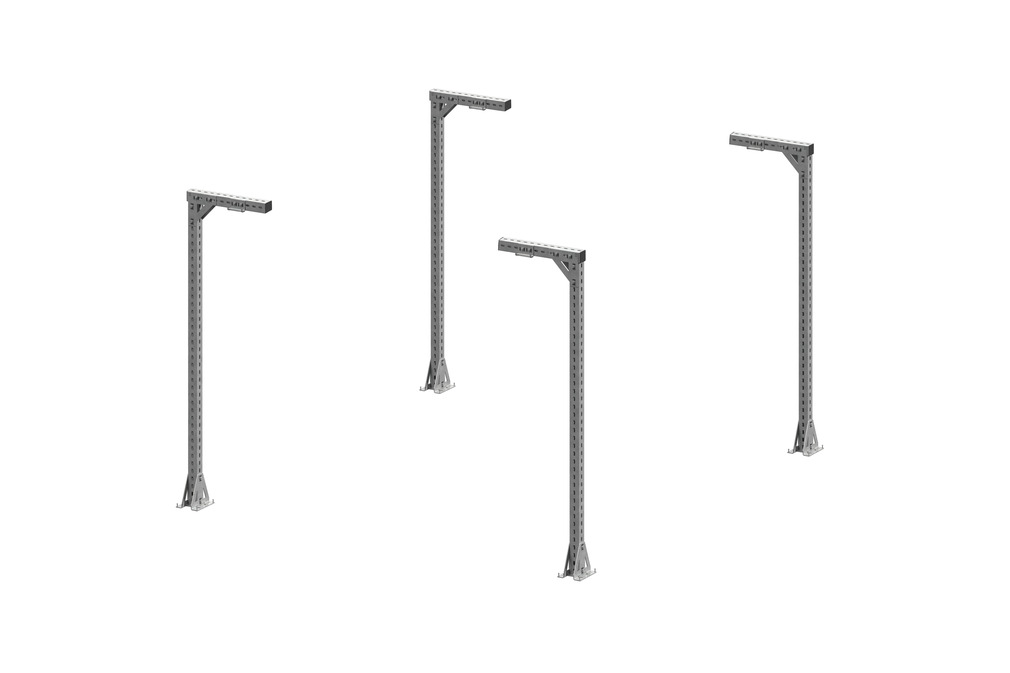


Anchor Set
High-quality injection anchors
Required concrete thickness: min. 200 mm; required concrete quality: min. B25 or C25/235
No additional foundation required
For loads up to 1,000 kg
Schmalz crane systems are versatile and feature exceptionally smooth operation, even in hazardous areas. Their optimized weight-to-load ratio enables effortless handling of heavy workpieces. The even load distribution on all load-bearing rollers prevents the transport trolleys from tilting and ensures particularly smooth running. The modular design allows an individual version to be achieved as a jib crane or overhead crane system in combination with the appropriate lifting device. With their high flexibility, Schmalz crane systems are the ideal solution for a wide range of applications.
Ergonomic handling thanks to outstanding low-friction operation and low moving mass
Cost-efficient adaptation to individual requirements and lift capacities
Available as a turnkey system with vacuum tube lifter and aluminum crane system for hazardous areas
Can be used throughout Europe without country-specific certificates thanks to certification according to ATEX Directive 2014/34/EU


Lightweight and Durable Aluminum Profile
Weight-optimized extruded profile with hollow-chamber geometry (weight from 3 kg/m)
Reinforced vertical support provided by an internal web
Material: natural anodized aluminum (EN AW 60 63 T66)
Five profile sizes for loads up to 1,200 kg
Profile lengths up to 8,000 mm, expandable as required using rail connectors
Dovetail for subsequent mounting of variable end stops
Side notches for connecting accessories

Smooth-running Transport Trolley
Sturdy die-cast aluminum construction with chemically nickel-plated coating
Safe connection of all types of lifting devices
Optimal running characteristics thanks to large castors made of high-performance polymer
Including grounding point for equipotential bonding in hazardous areas

Cable Trolley for Energy Supply
Most common type of energy supply via cable trolley in aluminum profile
Made of stainless steel with polymer rollers, including equipotential bonding
Easy mounting thanks to pre-assembled cable trolleys

Sealing Plate
Visually appealing stainless steel end caps, including equipotential bonding
Protection against soiling
Hinged for easy maintenance and inspection

Equipotential Bonding
Integrated grounding points for all components
Safe equipotential bonding between all system components

Smooth‑running Slewing Bearing
Effortless swiveling even close to the swivel bearing
Easy mounting even in low headrom conditions thanks to two separate bearing bolts
Maintenance-free plain bearing

Pillar
High-quality welded steel construction, painted in RAL 7035 light gray (special coatings available on request)
Ready to plug for easy mounting
Compact base plate dimensions (400 × 400 mm to 950 × 950 mm)
Includes equipotential bonding

Wall Bracket
High-quality welded steel construction, painted in RAL 7035 light gray (special coatings available on request)
Flexible mounting using dowels, brackets or back-plate mounting on existing walls and pillars
Includes equipotential bonding

Height-adjustable I-Beam
Most common suspension for overhead crane systems
Compensation of height differences in the ceiling construction up to 30 mm
Available in pendant and rigid version
Includes equipotential bonding

Anchor Plates for Concrete Ceilings
Special high-performance anchors with certification for dynamic loads
Required concrete quality C20/C25, concrete thickness at least 200 mm
Available in pendulum and rigid version
Includes equipotential bonding

Clamping for Wooden Beams and Glulam Beams
Safe mounting on wooden beams and glulam beams
Includes equipotential bonding

Riser
Lifts the crane girder to the level of the crane runway
Reduces the overall height of crane systems in low-headroom conditions or passageways
Includes equipotential bonding

Type | Overall height [mm] | Weight [kg/m] | Max. load capacity [kg] | Area moment of inertia [cm4] lx | Area moment of inertia [cm4] ly | Moment of resistance [cm3] wx | Moment of resistance [cm3] wy |
|---|---|---|---|---|---|---|---|
SRA-100 | 100 | 3,1 | 125 | 89 | 112 | 21 | 25 |
SRA-105 | 105 | 5,5 | 250 | 244 | 253 | 48 | 51 |
SRA-140 | 140 | 7,8 | 500 | 384 | 651 | 92 | 77 |
SRA-180 | 180 | 9,2 | 800 | 457 | 1.283 | 145 | 92 |
SRA-220 | 220 | 10,7 | 1.200 | 544 | 2.281 | 207 | 109 |
SRA-80-V* | 80 | 4,1 | - | 144 | 177 | - | - |
*Reinforced profile suitable for SRA-140, SRA-180 and SRA-220
The load diagram can be used to select the profile size taking into account a specific load capacity and the suspension distances. The specified suspension distances are based on a deflection of 1:300, the usual value for calculating crane systems. For certain applications, smaller deflection values such as 1:400 may be required.
Example: With a load capacity of 200 kg and a specified suspension distance of 5,000 mm, the SRA-140 profile is used. The maximum deflection is then 17 mm (5,000 mm / 300).
Calculation basis: DIN EN 13001
Lifting class: HC3
Load group: S1

Column-mounted jib crane EX
Aluminium crane rail
Connection to a Schmalz crane column
Swivel angle up to a maximum of 270°
For loads up to 140 kg

Wall-mounted jib crane EX
Aluminium crane rail
For connection to the existing hall construction
Slewing angle up to a maximum of 180
For loads up to 140 kg

Articulated-arm jib EX
Easy maneuvering around obstacles such as hall columns or machines thanks to jib with additional joint
Large usable room height and avoidance of interfering contours thanks to integrated vacuum guide
For loads up to 85 kg
Outrigger lengths of 3,000 mm and 4,000 mm available
Column or wall-mounted version possible

Overhead crane system EX
Aluminium crane rail
Connection to the ceiling structure or to a Schmalz steel structure KBG
Particularly suitable for large working areas
For loads up to 1,200 kg
High-quality injection anchors
Required concrete thickness: min. 200 mm; required concrete quality: min. B25 or C25/235
No additional foundation required
For loads up to 1,000 kg

No mounting on the floor required
Easily transportable by forklift truck or pallet truck
Dimensions from 1,200 x 1,200 mm to 1,470 x 1,470 mm
For loads up to 200 kg (depending on boom length)

Stop for individual adjustment of the slewing range
Slewing range limit per side: 0° to 100°

For mounting the wall bracket to an existing hall column or pillar

Counter plate with through-holes for mounting on walls